
Americano – what kind of coffee is it and how to make a perfect americano at home?
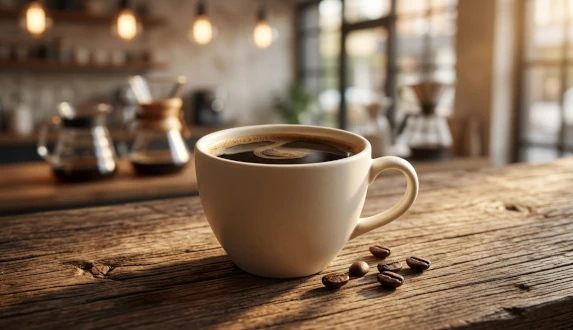
In a world full of fancy coffee-based drinks, complicated brewing methods, and never-ending coffee trends, sometimes what we crave most is a simple, black, and aromatic classic. This is exactly where americano coffee steps onto the stage. For many of us, it is the absolute foundation of the morning, a lifesaver on sleepy afternoons, and the perfect companion to a dessert. But what exactly is this popular drink, and why has it gained worldwide recognition?
In this post, we will take a closer look at this fascinating brew. We will explain and answer the most important questions: what exactly is an americano, where did its name come from, and how does it differ from other black coffees? We will also dispel common myths about its strength and present a reliable americano coffee recipe, thanks to which you will achieve an effect worthy of the best café in the comfort of your own kitchen. We will guide you step by step on how to make americano to extract the very best from the beans, and we will consider whether an americano with milk is a culinary crime or an acceptable variation. Regardless of whether you choose intense beans for a classic Italian espresso, or prefer lighter-roasted, fruity profiles, remember that fresh, top-quality coffee is the foundation of every successful mug. Ready for a dose of knowledge? Let's get started!
Summary:
- Americano coffee – what is it and where does it come from?
- Americano – how to make it step by step (recipe)
- Americano with milk – is it a good idea?
- Most common mistakes when making americano coffee
Americano coffee – what is it and where does it come from?
Let's start with the basics. Many beginner coffee drinkers, looking through a café menu, ask themselves: what exactly is an americano? The definition is incredibly simple, but it hides a great potential of flavour. An americano (from Italian caffè americano) is nothing more than a single or double espresso that has been diluted with hot water. That is all there is to it. The addition of water means the volume of the drink increases significantly, resembling a traditional large black coffee, but the base in the form of an essential espresso gives it a completely different, unique character.
To understand why this particular drink took such a form, we have to go back in time to the period of the Second World War. It was then, according to the most popular theory, that this coffee was born. Today, americano coffee is an absolute standard all over the world, but its origins were dictated by pure necessity and the clash of two completely different coffee cultures.
🧐 Good to know: History has it that American soldiers stationed in Italy during World War II were not entirely fond of the traditional Italian espresso. It was too small, too intense, and too bitter for them. They were used to the large mugs of mild filter coffee they drank back home. To adapt the local beverage to their preferences, they started asking baristas to top up their espresso portions with a large amount of hot water. The surprised Italians called this specific invention caffè americano, which literally means "American coffee".
Over time, this wartime invention moved across the ocean, and then conquered the entire globe. Currently, the americano is the perfect compromise for those who appreciate the deep extraction process of an espresso, but want to enjoy their drink for a bit longer than just two or three sips.
Taste, aroma, and characteristics of an americano
What kind of coffee is an americano? If you are wondering how an americano performs in sensory terms, you must know that the flavour profile of this drink is a fascinating hybrid. On one hand, due to the addition of water, it is much milder and less thick than a pure espresso. On the other hand, it retains the specific flavour notes that can only be achieved by brewing coffee under high pressure (in an espresso machine or a moka pot basket). This makes the brew possess a depth that is often lacking in standard pour-overs.
How does the comparison of americano vs black coffee brewed using alternative methods look in this context? Regular filter coffee usually has a very clean, almost tea-like body and more clearly highlights the fruity, acidic notes of the beans. An americano, despite being diluted, retains a bit more of the weight from the espresso, a delicate dose of pleasant bitterness, and darker, chocolate-nutty accents (depending, of course, on the beans used). Moreover, in an americano, we will often experience remnants of crema – the thick, nutty foam characteristic of an espresso, which does not appear in filtered coffees at all.
Here are the most important characteristic features of this drink:
- ✔️ complex aroma: thanks to the espresso base, intense essential oils are released from the beans in an americano, yielding a rich, deep scent;
- ✔️ mild body: the drink is lighter and less syrupy than espresso, making it ideal for longer sitting sessions;
- ✔️ versatility: it tastes excellent both on the basis of dark-roasted beans (chocolate, caramel notes) and light-roasted speciality beans (floral and fruity notes);
- ✔️ drinkability: due to its volume (usually from 150 to 250 ml), an americano is a great choice for a morning breakfast or an afternoon book.
Is an americano stronger than an espresso?
This is one of the questions most frequently asked by our customers. The issue of americano vs espresso stirs up a lot of emotions and is based on a frequent confusion of two completely different concepts: flavour intensity and total caffeine content.
Many people assume that since an americano is a large mug of black coffee, it must be "weaker" and provide less of a kick than a small, black, tarry shot of espresso. Others, in turn, think that a large volume of the drink means a huge dose of caffeine. The truth is much simpler, but requires an understanding of proportions.
Regardless of how much hot water you add to your mug, the base remains unchanged. If your americano is made on the basis of a single double espresso (a so-called doppio), then it contains exactly the same amount of caffeine as that same double espresso drunk without the addition of water. Water does not flush out or add caffeine to an already finished brew.
📌 In short: intensity vs caffeine
Espresso is characterised by a very high flavour intensity and thickness. Its taste hits you immediately, which is why it seems "stronger" in sensory reception. We consume the caffeine quickly, in just a few sips.
Americano has a lower flavour intensity – it is diluted, milder, and devoid of the striking bitterness of a shot. However, in terms of stimulating power, it contains an identical amount of caffeine (assuming the use of the same portion of espresso). The difference is that drinking an americano takes us more time, so the caffeine is released into the body slightly slower and more gently.
Therefore, if you care about a solid stimulation, but you don't like the very tart or thick taste of coffee essence, preparing a proper americano is a spot-on choice!
Americano – how to make it step by step
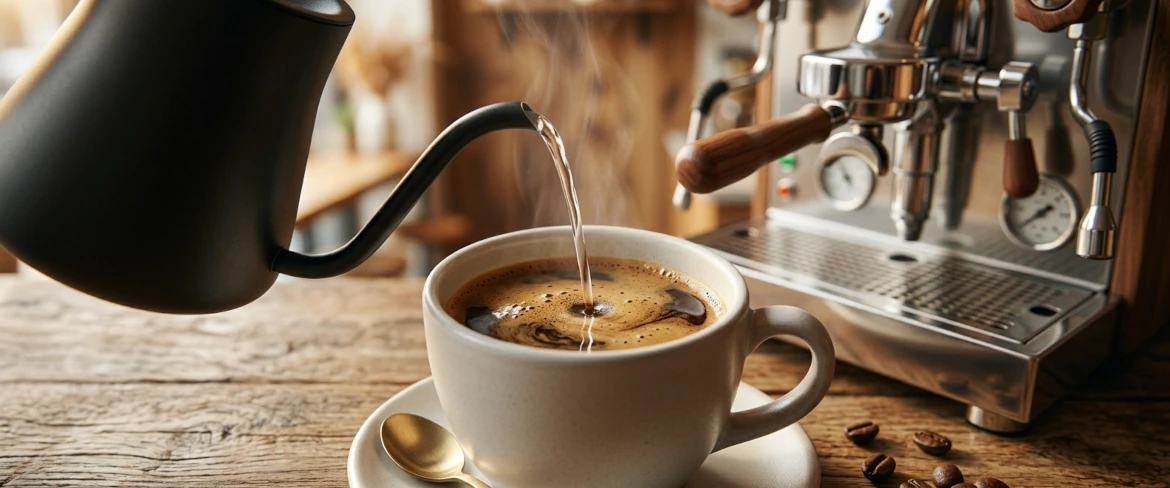
Let's move on to practice. Now that we know what kind of drink we are dealing with and what its history entails, it's time to answer the key question: how to make americano in your own home? Contrary to appearances, preparing a perfect mug of this classic coffee is about more than just mindlessly pouring boiling water into the essence. To bring out the full flavour of speciality beans and enjoy a brew like from a professional café, it is worth sticking to a few simple but extremely important rules.
If you want to make the ideal americano coffee, below you will find a proven, homemade americano coffee recipe, which will guarantee you the perfect balance of flavour, proper body, and beautiful crema on the surface of the brew.
Americano coffee recipe
The key to success is not only the quality of the beans used, but also the water temperature and... the correct order of combining the ingredients. See how to prepare this drink step by step.

☕ Recipe for a perfect americano
Ingredients:
- A single (approx. 30 ml) or double (approx. 60 ml) espresso made from your favourite beans
- Hot, filtered water at a temperature of approx. 90-95°C – 120-240 ml, depending on whether the base will be a single or double espresso.
Preparation:
- Warm the vessel: rinse your favourite cup or mug with a little hot water. Thanks to this, the coffee will maintain the right temperature for longer.
- Prepare the water: measure the appropriate amount of water needed to prepare the espresso. Tip: avoid boiling water, which will make the brew flat and unpleasantly bitter!
- Brew the base: prepare an intense, aromatic espresso.
- Combine the ingredients: first, pour the hot water into the cup, and only then slowly and gently pour the prepared espresso down the side of the cup. This order allows you to preserve the appetising, nutty crema on the surface.
As you can see, the process is extremely quick, and sticking to the barista rule "water first, then coffee" can drastically change the visual and sensory perception of the drink – by pouring water into the espresso, we break up the crema and oxidise the brew faster.
Proportions: how much water to espresso in an americano?
One of the biggest advantages of an americano is that you can fully adjust it to your personal preferences. There is no single strict rule when preparing an americano, but the most commonly used proportions are from 1:1 to 1:4 (where the first value is espresso, and the second is water). Everything depends on how intense a flavour you ultimately want to achieve.
Here are standard guidelines to start your home testing with:
- ✔️ From a single espresso (approx. 30 ml of coffee): you usually pour 90-120 ml of water. This results in a small, highly balanced coffee with a total volume of approx. 120-150 ml (ideal for a typical cup).
- ✔️ From a double espresso (approx. 60 ml of coffee): you usually pour 120-180 ml of water. This is the most common café standard, yielding a medium mug of the drink (approx. 200-240 ml). This way, we get a solid dose of caffeine and a clearly perceptible character of the beans.
💡 Barista tip: If you like a very mild coffee, you can increase the amount of added water to even 250 ml (which gives a proportion of approx. 1:8). Remember, however, that with such a large amount of water, the taste of the espresso will be heavily dispersed, and the brew will lose its characteristic body and depth.
The best solution is simply experimenting. If you choose dark-roasted beans with notes of dark chocolate, a larger amount of water can pleasantly soften their heaviness. On the other hand, with fruity, lighter-roasted coffees, a smaller dose of water will allow you to preserve the crisp acidity and distinct aroma of the sensory profile.
Equipment for preparing an americano – espresso machine, moka pot, and other alternatives
The golden rule says that a true americano is based on espresso, and by definition, this is prepared in an espresso machine. It is precisely the high pressure (usually 9 bars) that allows extracting from finely ground beans this incredibly thick, syrupy essence, which gives the americano its characteristic flair.
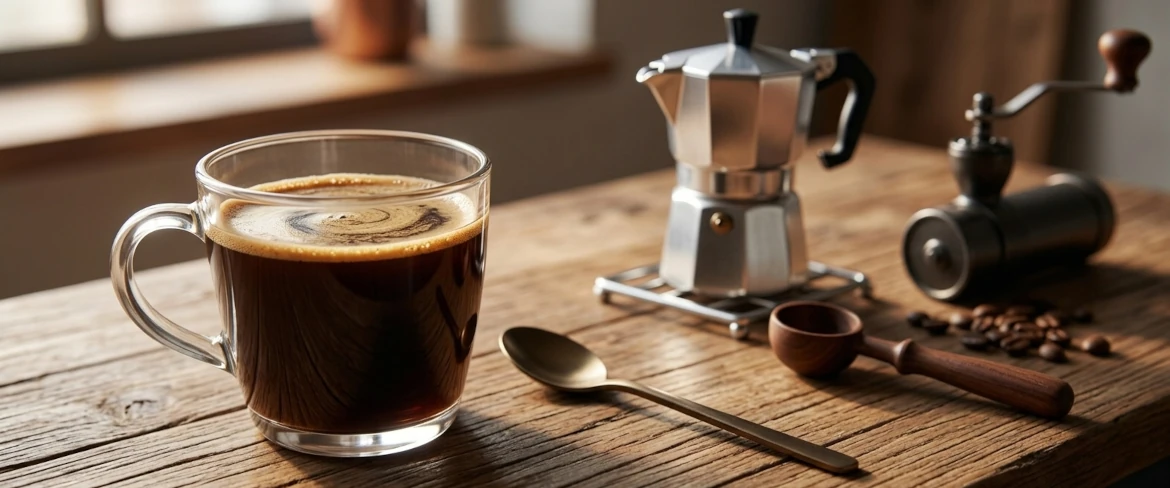
But what if you don't have professional equipment at home? All is not lost! You can also create an excellent base using other coffee makers that allow you to brew a high-intensity infusion. The best and most accessible alternative will be the classic Italian moka pot.
A brew from a moka pot is strong, essential, and serves as a great starting point for creating a homemade americano. Just brew the coffee according to proven rules, and then dilute it with hot water in your preferred proportions. If you want to find out how to extract maximum flavour from this inconspicuous device and avoid unpleasant bitterness, be sure to check out our article: How to make coffee in a moka pot? A practical guide to help you brew the perfect stovetop coffee!
Other methods from which you can obtain an intense brew resembling the essence are also the AeroPress (using a short brewing time and a smaller amount of water) or special pressurised baskets. Remember, however – the most important thing is the quality of the beans and your joy of drinking good coffee!
Americano with milk – is it a good idea?
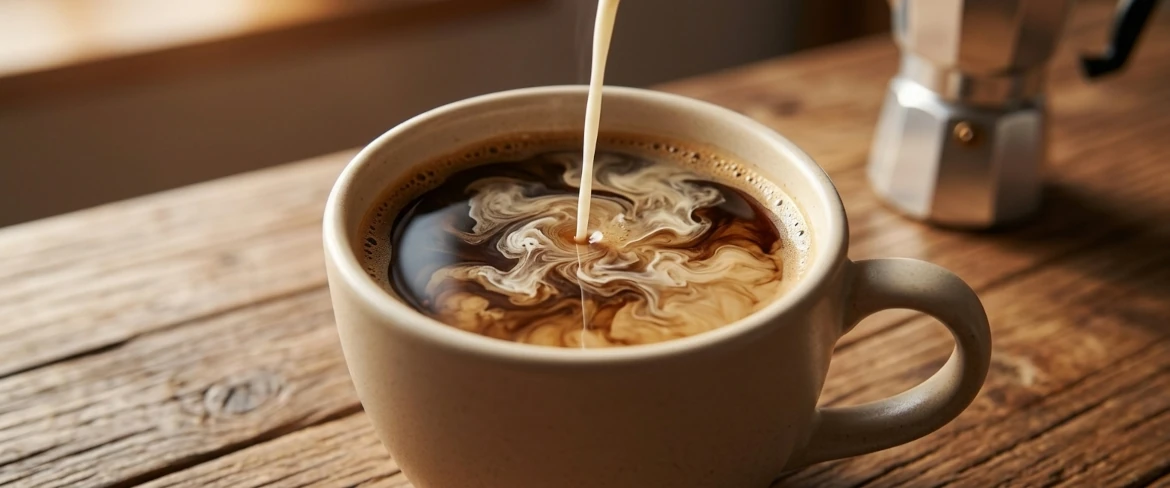
When you ask about adding milk to a black brew in the speciality coffee world, some baristas might hold their breath for a fraction of a second. The truth is, however, that the best coffee is the one that tastes best to you! That is exactly why an americano with milk is not a culinary crime at all, but simply one of many paths to finding the perfect balance in your cup. It is worth knowing, however, how the addition of dairy (or a plant-based beverage) affects the structure of the brew and how such a version differs from other items on the café menu.
Does a classic americano contain milk?
The answer is short and firm: no. A true, canonical americano consists solely of two ingredients – a perfectly brewed espresso and hot water. We won't find a single drop of milk in it. Where, then, did so much confusion around adding a white addition to it come from?
This misunderstanding largely stems from naming conventions and our daily habits. Many people treat the term "americano" simply as a synonym for a large black coffee. Since we eagerly pour milk into a pour-over or filter coffee machine brew at home, the natural reflex is to ask for the same addition when ordering an americano at the bar. What's more, in many countries (especially in the UK or in popular chain stores), a completely separate term has emerged – white americano. It is an official menu item, simply being a classic americano with room left for a top-up of cold or warm milk.
How to prepare an americano with milk?
If you care about breaking the black profile of your brew, preparing an americano with milk is extremely simple. We start exactly as in the case of the traditional version: we combine hot water with essential espresso. Only to such a prepared base, at the very end, do we add a splash of milk, approx. 20-40 ml. You can use cold milk, which will make the drink immediately reach the ideal temperature for drinking, or warm it slightly so as not to cool the coffee down.
How does such an addition affect the properties of the drink?
- ✔️ Texture change: the coffee loses its raw, watery cleanness in favour of a slightly smoother, more velvety feel on the tongue (mouthfeel).
- ✔️ Rounding off the flavour: fats and proteins contained in milk perfectly mask any bitterness coming from darker-roasted beans, and also soften the crisp acidity of fruity profiles.
- ✔️ Natural sweetness: lactose subtly sweetens the brew, often eliminating the need to add sugar.
Very often, customers also ask us how an americano with milk differs from classic milky coffees. We have prepared a short summary that will dispel these doubts once and for all!
| Feature | Americano with milk | Latte / Flat White |
|---|---|---|
| Base for diluting the espresso | Hot water | No water (milk only) |
| Amount and structure of milk | A small amount, cold or warm, unfoamed | A large amount, hot and foamed (creating foam on top) |
| Texture of the drink | Thinner, lighter, retaining a typical "coffee" body | Thick, velvety, highly creamy |
| Dominant flavour profile | A distinct character of coffee beans, which the milk only subtly softens | Clearly milky, sweet, and delicate, with coffee as a background complement |
Most common mistakes when making americano coffee
Americano coffee seems like a trivial drink to prepare – after all, it is just essence and water. However, the catch lies precisely in this simplicity. When we are dealing with just two ingredients, every mistake at the brewing stage grows to the rank of a sensory disaster. What goes wrong most often when we try to recreate a café classic in the comfort of our own kitchen?
Wrong proportions of water and espresso
The most common sin of beginner home baristas is a lack of moderation in pouring water. As we have already mentioned, the optimal proportion is usually from 1:1 to 1:4. If you pour too much water into a single shot, you will get a sad, diluted, brownish drink, devoid of body and any expression – often referred to by coffee lovers as "dirty water".
On the other hand, too little water will make the brew unpleasantly aggressive and overwhelming, and this is not what we want when we fancy a relaxing, longer coffee. How to avoid this?
- ✔️ Use a scale: measure the water (in millilitres or grams) with the same precision with which you prepare the base espresso. Do not pour boiling water "by eye"!
- ✔️ Adjust the volume of the vessel: if you use a 350 ml mug, making an americano in it from a single espresso (30 ml) and topping it up with water to the brim will ruin the taste. In such a case, always reach for a double base (doppio).
Improper coffee quality and grinding
Remember the most important rule: an americano will be exactly as good as the espresso from which it was made. Water will not magically fix extraction errors – at most, it will hide them for a moment, and after the drink cools down, it will ruthlessly highlight them.
If you use low-quality, old, stale beans, or simply beans poorly matched to your preferences, your americano will come out flat and unpleasantly bitter. It is worth getting to know your own taste well right at the beginning. If you have trouble distinguishing between particular profiles, be sure to read our guide: Coffee acidity and bitterness – how to choose the perfect beans for your taste.
Another key issue is the coarseness of the coffee grind. For the espresso (and thus our americano) to come out perfectly, you must ensure appropriate grinding. Coffee ground too coarsely will let water through too fast – it will be under-extracted, and its taste will be tart and sour, whilst ground too finely – it will offer too much resistance, will be over-extracted, and an astringent bitterness will be palpable in the taste. Furthermore, using pre-ground coffee is voluntarily depriving yourself of the most beautiful aromas. We write in detail about how important a grinder and freshly ground coffee are here: Coffee grinding – why do freshly ground beans change the taste of coffee?
To sum up, americano coffee is a classic beautiful in its simplicity, which deserves a place in the repertoire of every caffeine lover. Regardless of whether you drink it first thing in the morning for a solid stimulation, or slowly savour it during an afternoon read – the key to success is always fresh, artisan-roasted beans. Get your favourite mug out, take care of the right water temperature, and treat yourself to a moment of well-deserved relaxation with a perfect, black classic.
It is time to put theory into practice – let your next americano be the best you have ever had!
FAQ – najczęściej zadawane pytania o kawę americano
1. Americano – what kind of coffee is it?
Americano coffee is a very popular drink made on the basis of a single or double espresso, to which hot water is added. The name refers to American soldiers who, while stationed in Italy during World War II, diluted thick espresso with water to make the taste and volume of the brew resemble the traditional black filter coffee known from their homeland.
2. Americano vs espresso – how do they differ?
The main difference between an americano and an espresso lies in the volume and intensity of flavour. An espresso is only approx. 30 ml of thick, highly condensed essence brewed under high pressure. An americano is exactly the same espresso enlarged by the addition of 90 to even 200 ml of water. An americano is milder in taste and allows you to enjoy the drink for much longer, however, in terms of caffeine content, both forms are identical (assuming the use of the same portion of base).
3. Americano – what does this coffee taste like?
The flavour profile of an americano perfectly combines the depth of an espresso with the lightness of black filter coffee. It is a drink with a balanced, complex aroma. Depending on the beans used, you can sense dark chocolate-nutty notes or crisp fruity accents in it. Unlike pure espresso, an americano has a lighter, less syrupy body and significantly less bitterness.
4. Do you add milk to an americano?
A classic americano coffee recipe is based solely on two ingredients: good quality espresso and hot water. Over time, however, an americano with milk (often referred to as a white americano) gained popularity. Adding a splash of cool or warm milk at the very end of preparation is an excellent way to soften the flavour profile, reduce any bitterness, and give the brew a smoother texture.
5. What coffee to use to prepare an americano?
It all depends on your personal preferences! Since the base of this drink is espresso, beans intended for espresso machines or moka pots will work best. Lovers of strong, traditional flavours should opt for medium or dark-roasted beans (e.g., from South American regions). Fans of fruity acidity can successfully use light-roasted speciality beans (e.g., from Africa). The most important criterion, however, always remains the freshness of the beans.
Recommended
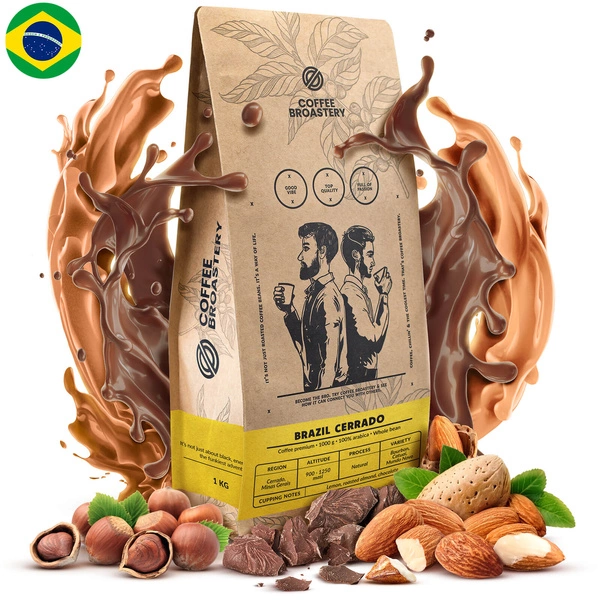
Coffee Broastery - Whole Bean Coffee Brazil Cerrado Premium 1kg

Coffee Broastery - whole bean coffee Brazil Mogiana Premium 1kg

Coffee Broastery - Whole Bean Coffee Brazil Guaxupe Premium 1kg
