
Vietnamese coffee – recipe with condensed milk
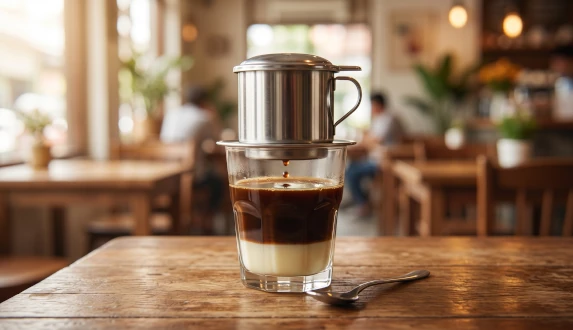
Are you looking for a brew that will brutally kick-start your morning with a caffeine punch, while simultaneously delighting you with a dessert-like, velvety sweetness? Traditional vietnamese coffee, known locally as Cà Phê Sữa, is more than just another way to supply your body with caffeine. It is a true ritual from Southeast Asia that has gained popularity all over the world.
It stands out not only because of the unique balance between the strength of dark roasted beans and the thick, sweet addition, but also due to the mesmerising brewing process. If you are wondering how to recreate this flavour in the comfort of your own home, you have come to the right place. In this post, we will delve into the secrets of this beverage – you will find out what equipment is needed, learn the original recipe for vietnamese style coffee, and we will also advise you on how to drink it to fully appreciate its rich sensory profile.
Summary:
- What is vietnamese coffee and what makes it stand out?
- Vietnamese coffee – which maker to choose?
- Vietnamese coffee recipe with condensed milk
- Vietnamese coffee served cold and hot
- Vietnamese coffee – how to serve it?
- Vietnamese coffee at home – practical tips
What is vietnamese coffee and what makes it stand out?
Compared to popular European brewing methods – such as Italian espresso, a delicate drip, or a classic French Press – vietnamese coffee appears to be an uncompromising method. Its uniqueness does not stem from the use of expensive pressurised machines, but from the perfect combination of three elements: specific beans, a traditional vietnamese coffee maker, and an addition that historically arose from necessity, but today defines the beverage's identity.
Before we move on to the details of extraction, however, it is worth remembering one golden rule of every barista: a perfect brew begins with perfect raw materials. Regardless of the brewing method you choose, freshly roasted beans are the foundation. If you are planning some home experiments, visit the "Coffee" category in our shop and choose beans with a darker roasting profile, which will perfectly complement the thick sweetness.
So what makes vietnamese style coffee so special? It is primarily the culture of slow coffee. In Vietnam, it is believed that if coffee drips into the glass too quickly, it is simply not worth drinking. It is a beverage that teaches patience and allows for a moment of reflection before we dive into the whirlwind of daily duties.
Vietnamese coffee – characteristics of the beans and flavour
The key to understanding the Vietnamese flavour is realising that Vietnam is a global powerhouse in cultivating the Robusta variety. While the speciality market in Europe is dominated by delicate and acidic Arabica, the Vietnamese ritual celebrates the raw power of Robusta.
These vietnamese coffee beans are characterised by almost twice the caffeine content of Arabica. Their flavour profile is deep, heavy, with distinct notes of dark chocolate, roasted nuts, and often a slightly smoky or earthy finish. The Vietnamese have also developed a very specific style of roasting the beans. Traditionally, at the end of the roasting process, butter, cocoa, and sometimes even a pinch of salt or whiskey are added to them. Thanks to this, the beans gain a slightly oily coating and an incredibly rich, caramel-cocoa aroma that heralds a powerful experience in the cup.
🧐 Good to know: Where did the Vietnamese custom of drinking coffee with canned condensed milk instead of fresh milk come from? Coffee was introduced there in the mid-19th century by the French, who loved their café au lait. Unfortunately, breeding dairy cows in the tropical climate was nearly impossible, and fresh milk spoiled in the blink of an eye. Thick, sweetened condensed milk turned out to be an ideal and long-lasting substitute. This is how a powerful tradition was born out of necessity (or rather, a lack of milk)!
Why is vietnamese coffee so intense?
The secret to the striking strength of this beverage lies not only in the Robusta beans themselves but also in the physics of brewing. For a genuine vietnamese coffee to end up in your glass, a traditional vietnamese coffee filter is used for a very slow, condensed extraction. We are talking about a device called a phin – a small, metal filter with a press, which is placed directly on top of the glass.
The intensity of the brew results from several key factors:
- ✔️ large dose of coffee, little water: a relatively large amount of finely ground coffee is used in proportion to the volume of water, giving an effect almost akin to a thick, long espresso;
- ✔️ long contact time with water: the coffee in the phin filter drips drop by drop. Such slow extraction (lasting about 5 minutes) "pulls" the maximum amount of caffeine and heavy, oily flavour compounds from the beans;
- ✔️ lack of a paper filter: the metal mesh allows coffee particles and natural oils to pass through (unlike drip filters), which gives the brew a thick, "dirty", and very full-bodied structure.
Because of such an immense concentration of bitterness and caffeine, classic vietnamese coffee with condensed milk is practically a necessity, not just a whim. The extremely sweet, sticky milk at the bottom of the glass creates a barrier that, once stirred, perfectly counters the weight of the brew. In this way, a beverage is created that is like a liquid dessert, providing energy for half the day!
📌 In short: The intensity of Vietnamese coffee is the resultant of a massive dose of caffeine from the Robusta variety, the specific roasting of the beans, and a very slow, thick extraction through a traditional metal phin filter.
Vietnamese coffee – which maker to choose?
When discussing an authentic Eastern ritual, we cannot overlook the issue of equipment. Tradition is of great importance here, because it is this specific extraction method that gives the brew its incredible texture. However, before you start looking for specialist gear, we have good news: the speciality coffee world loves experiments! As experts, we know that understanding the classic rules is the first step to being able to consciously – and successfully – modify them at home.
The Phin dripper – how does it work and why is it crucial?
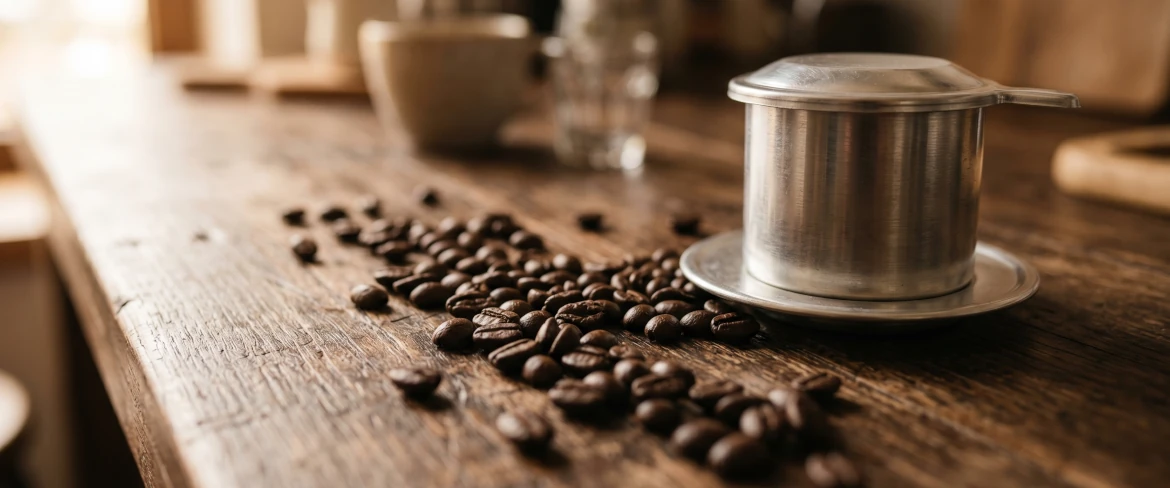
In traditional cafes in Hanoi or Saigon, the phin reigns supreme. It is a very simple, non-pressurised device consisting of a metal saucer, a perforated cup, an internal press to tamp the beans, and a lid. The whole thing is placed directly on a glass with previously prepared condensed milk.
From a technical point of view, this traditional vietnamese coffee dripper acts as a fascinating hybrid – it combines full immersion of the beans in hot water with a slow drip. Its operation relies entirely on gravity. The ground coffee is pressed down with the insert, which creates resistance against the hot water. The extraction is slow – drops fall steadily to the bottom of the glass, and the absence of a paper filter ensures that all natural essential oils and the finest bean particles make their way into the brew. It is thanks to this that the phin dripper creates a coffee with such a full body and a thick, almost syrupy consistency, which perfectly merges with the sweetness of the milk.
Can you make vietnamese style coffee without a phin dripper and using Arabica?
The short answer is: Yes, absolutely! Although orthodox fans of Vietnamese culture might raise an eyebrow at this point, the room for experimentation is huge. Since we champion the highest quality in our shop and offer exclusively 100% Arabica, we know perfectly well how to adapt this recipe to European speciality standards.
Before we move on to equipment, let's discuss the beans. Traditional Robusta is bitter and earthy, whereas Arabica is more delicate, complex, and often acidic. Sweetened condensed milk is very dominant, which means a lightly roasted Arabica can simply "disappear" under it. The solution is to use beans with a dark roast profile (e.g., dedicated for espresso; we recommend the Coffee Broastery Amico dall'Italia Espresso Roast), where chocolate, nutty, or caramel notes dominate. Avoid coffees with high fruity acidity (like those from Kenya or Ethiopia), because combining them with condensed milk produces a rather peculiar flavour effect.
💡 Pro-tip for experimenters: If you are preparing this beverage using Arabica, try adding a pinch of sea salt to the finished brew. Salt excellently neutralises the natural acidity of the beans and phenomenally brings out the sweetness of the milk, bringing the flavour profile closer to the one original Vietnamese coffee is famous for!
If you do not have a phin at home, your goal is simply to obtain a very thick, strong concentrate. Below, we present how other coffee makers handle this task:
- ✔️ moka pot: this is definitely the best substitute. To achieve the right strength, brew the coffee as usual, but use slightly more finely ground beans and a little less water. This way, you will get an intense coffee concentrate that will perfectly cut through the milk with its texture and bitterness. Check out our post: How to make coffee in a moka pot? A practical guide to help you brew the perfect stovetop coffee!;
- ✔️ AeroPress: a brilliant device that allows you to manipulate the strength. Use the inverted method, pour in 2-3 heaped teaspoons of coffee, and add only 80-100 ml of hot water. Press very slowly to get a clean and powerful concentrate;
- ✔️ French Press: increase the coffee dose (e.g., 30 g per 150 ml of water) and let it steep longer, even up to 5-6 minutes. The brew will have a suitable, heavy body;
- ✔️ espresso machine: the most common method in European cafes. A double espresso poured over condensed milk tastes sensational, although the brew will be smoother and devoid of the "dirty" aftertaste typical of metal filters.
Vietnamese coffee recipe with condensed milk
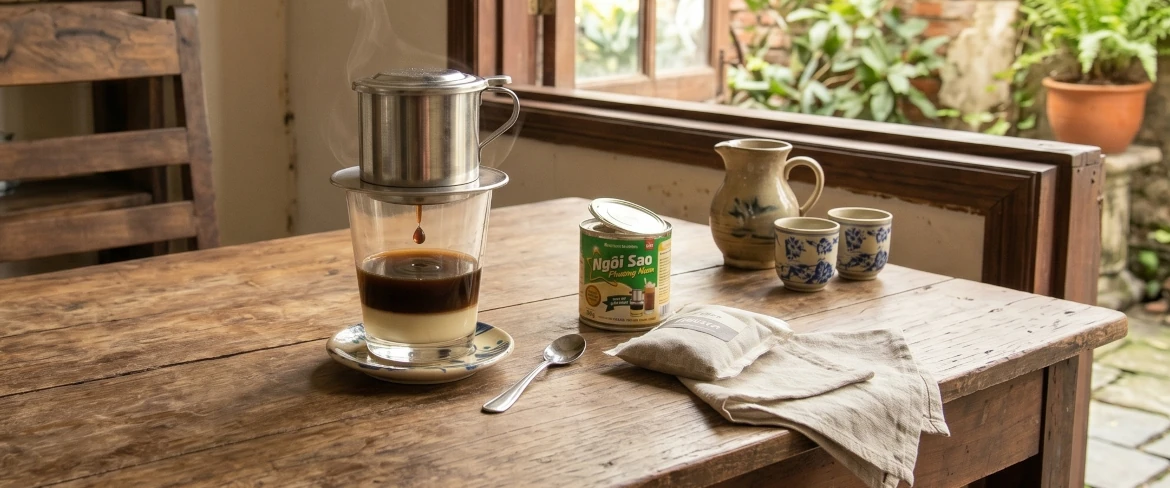
Once we have covered the theory and the choice of proper equipment, it is time to move on to the most important part – practice. The Vietnamese ritual is a wonderful lesson in patience, and below you will find the classic vietnamese coffee recipe that will guide you through this process step by step. Set aside a few minutes of peace and see for yourself that recreating an authentic Asian flavour in the comfort of your own kitchen is easier than you think!
Ingredients and proportions for vietnamese coffee
To prepare the perfect vietnamese coffee, you only need a few elements, but their quality and proper proportions are of key importance. In the spirit of tradition, the base would be a strong, dark roasted Robusta. However, if you are using your home setup, a dark roasted Arabica with a chocolate and nutty profile will work perfectly. Remember that the grind size is crucial – the coffee should be ground finer than for a drip, but slightly coarser than for an espresso.
It is worth making sure you grind the beans right before brewing. This way, you will preserve maximum aroma, which will blend wonderfully with the sweetness of the milk. You can learn more about this process from our article: Grinding coffee – why do freshly ground beans change the coffee taste?
To get one portion of thick, dessert-like brew, prepare:
- ✔️ 2-3 heaped teaspoons of freshly ground coffee,
- ✔️ 2 tablespoons of sweetened condensed milk (this is the heart of the beverage, guaranteeing its velvety texture),
- ✔️ hot water at a temperature of about 90-95 degrees Celsius (definitely avoid boiling water!),
- ✔️ optionally: ice cubes – if you fancy a refreshing, iced version.
The above proportions are an excellent starting point for any beginner lover of Asian flavours. Over time, you can, of course, freely modify them, tailoring the beverage to your own preferences.
If the brew seems too sweet to you, reduce the amount of milk next time, and if it lacks a caffeine "kick", use a bit more ground beans. Discovering the perfect balance is one of the greatest pleasures of home brewing!
How to brew vietnamese coffee step by step?
The brewing process itself using a traditional phin filter is an almost meditative experience. There is no room for rushing here, and gravity does all the most important work for us. The key to success is properly tamping the beans and the pre-infusion phase, which allows the coffee to release excess gases (the so-called bloom) and adequately prepares it to receive the rest of the water.
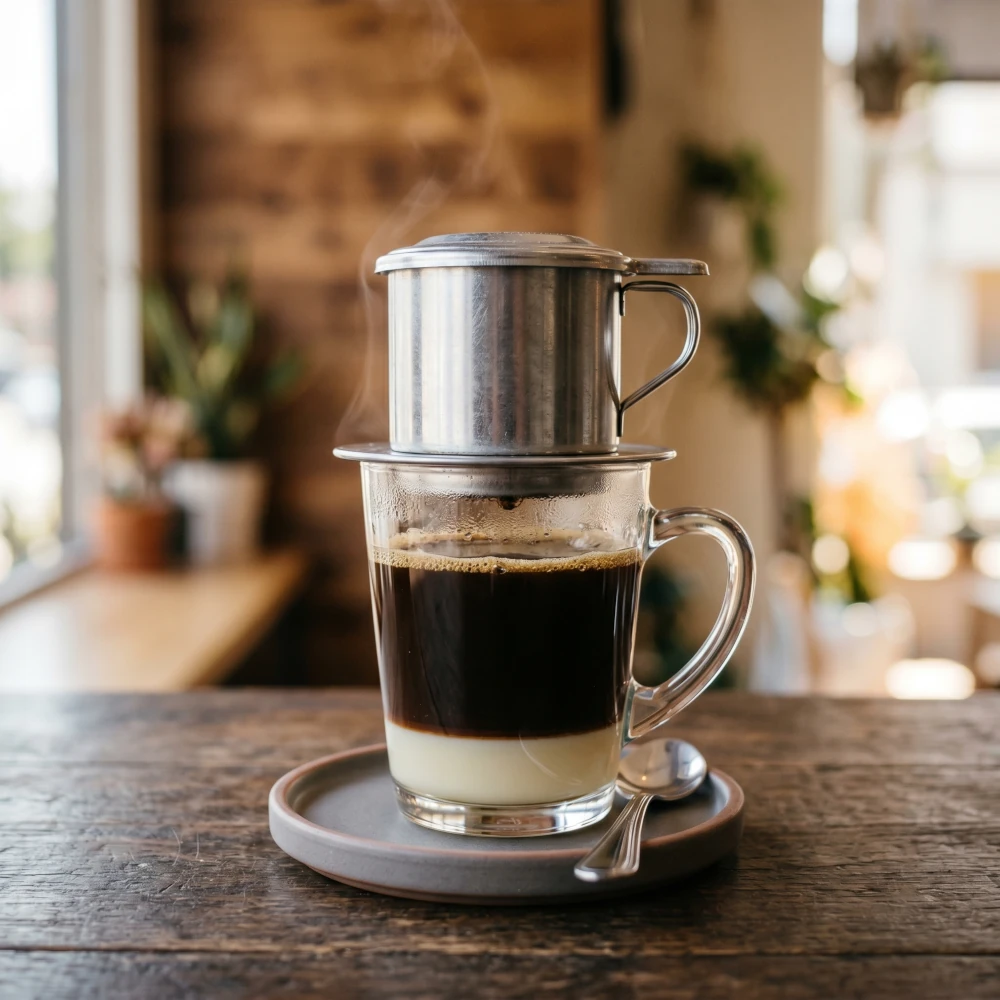
Before you begin, make sure you use a clear glass. Watching the thick, dark brew slowly descend onto the layer of light milk is an inseparable, visually mesmerising element of this unique ritual.
☕ Vietnamese coffee – recipe
- The base: pour the precisely measured condensed milk into the bottom of the glass.
- Preparing the filter: pour the ground coffee into the phin dripper, shake gently to level the surface, and then press down lightly with the internal insert.
- Pre-infusion: place the filter on the glass and pour in just a little hot water (approx. 10-20 ml). Wait 30 seconds for the coffee to swell.
- The main brewing: top up with water almost to the very brim of the dripper and put the lid on. The brew should drip very slowly – the whole process will take about 4 to 5 minutes.
- The finale: when the water has completely flowed through the filter, remove it. Use a long spoon to vigorously stir the black coffee with the milk from the bottom of the glass until the beverage takes on a beautiful caramel colour.
As you can see, preparing an original vietnamese coffee does not require complicated barista skills or expensive equipment. It does require a bit of dedication and patience, which makes it an ideal way to slow down the pace in the morning or enjoy a relaxing, sweet afternoon with a book in hand.
Once you have mastered the absolute basics and the classic version of this brew, a whole spectrum of new flavour possibilities will open up to you. Remember that every subsequently brewed cup of vietnamese coffee is an opportunity to modify the base recipe and tailor it one hundred percent to your own palate!
Vietnamese coffee served cold and hot
Vietnamese coffee culture is incredibly flexible and adapts perfectly to the time of day and the weather. The traditional division includes two main versions: hot and cold. The classic, warming vietnamese coffee with condensed milk (known as Cà Phê Sữa), which works brilliantly on chillier mornings, was discussed in detail in the previous part of this article.
However, considering the tropical, hot, and humid climate of Vietnam, it is the iced version that breaks true popularity records there. So if you are wondering how to drink vietnamese coffee on warm, summer afternoons to combine a powerful boost with maximum refreshment, you will find the answer below.
Iced vietnamese coffee – recipe
Iced vietnamese coffee, hiding under the melodious name of Cà Phê Sữa Đá, is a true lifesaver during peak temperatures. It stands out primarily because the addition of ice slightly dilutes the extremely thick brew, mellowing its intense sweetness and earthy bitterness. Thanks to this, the beverage becomes lighter to drink without losing its dessert-like, satisfying character.
To prepare this summer hit, you do not need to learn entirely new barista techniques or buy different beans. The base remains exactly the same as in the hot version. The secret lies solely in the method of serving and the rapid chilling of the freshly brewed essence.
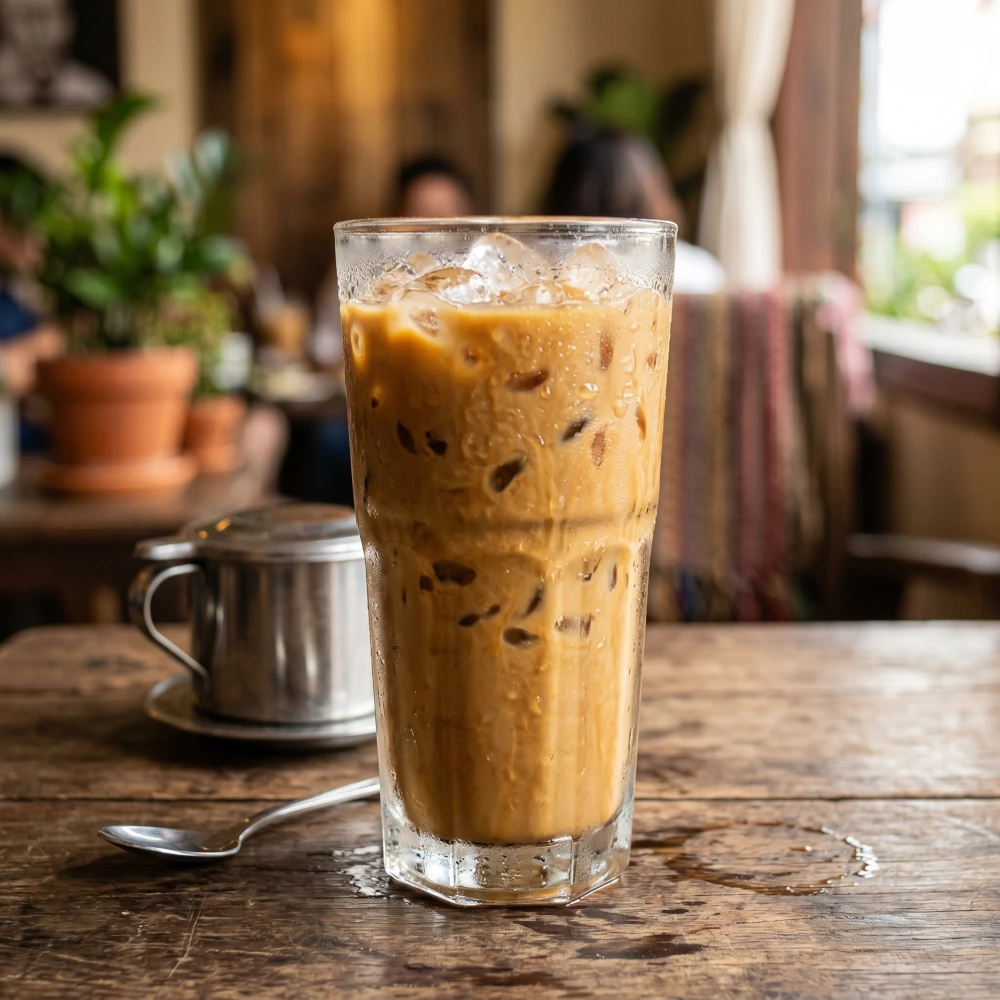
🧊 Iced vietnamese coffee – recipe
- Brew the base: prepare the coffee with condensed milk exactly as in our classic recipe (using a phin filter, moka pot, or AeroPress). Once the brew has dripped through, stir it thoroughly with the milk.
- Prepare the glassware: take a second, tall glass and fill it to the very brim with plenty of ice cubes.
- Chilling: pour the hot, caramel mixture directly over the ice.
- The finale: vigorously stir the whole thing again with a long spoon. The coffee will chill instantly, and the melting ice will give it the perfect, refreshing consistency.
Iced vietnamese coffee is a brilliant and much richer-tasting alternative to popular cafe frappés or a classic Iced Latte. Its sweet profile combined with the chill makes it an effective substitute for a full-fledged summer afternoon tea.
We guarantee that once you try this caramel-coffee refreshment, it will permanently feature on your holiday menu. Just bear one thing in mind – the low temperature and sweetness mask a powerful dose of caffeine, so drink it slowly and savour every sip!
The most interesting variants of vietnamese coffee – not just condensed milk!
The Vietnamese have demonstrated immense creativity in modifying their favourite coffee. Although the classic version with condensed milk is the absolute foundation, on the streets of Hanoi or Saigon you will find plenty of surprising and delicious variations. If you enjoy coffee experiments, be sure to check out these unconventional suggestions:
- ✔️ Cà Phê Trứng (egg coffee): the legendary "egg coffee" straight from Hanoi. Egg yolks whisked with sugar create a thick foam that makes the beverage taste and look like a liquid, fluffy tiramisu;
- ✔️ Cà Phê Cốt Dừa (coconut coffee): enriched with coconut milk or coconut ice cream. A creamy, tropical, and highly refreshing version, very often served as a blended, summery shake;
- ✔️ Cà Phê Muối (salted coffee): a famous beverage originating from the city of Hue, with the addition of sea salt and cream. The salt brilliantly enhances the sweetness of the milk and effectively neutralises the earthy bitterness of the coffee;
- ✔️ Bạc Xỉu (a clear predominance of milk): a version for those who find the classic Vietnamese brew simply too overpowering. You will find significantly more milk in it than coffee itself, which makes it very delicate and dessert-like.
Which of these versions sounds the best to you? The world of Vietnamese brews proves that with coffee you can, and indeed must, experiment, breaking the established moulds!
Vietnamese coffee – how to serve it?
Vietnamese coffee culture is not just about exceptional flavour and a massive dose of caffeine, but also a crucially important visual aspect. The method of serving plays an absolutely key role here, and the tasting itself is a true ritual that engages the senses long before the first sip is taken. If you want to fully recreate this Asian vibe in your own kitchen and impress your guests, you must keep a few traditional serving rules in mind.
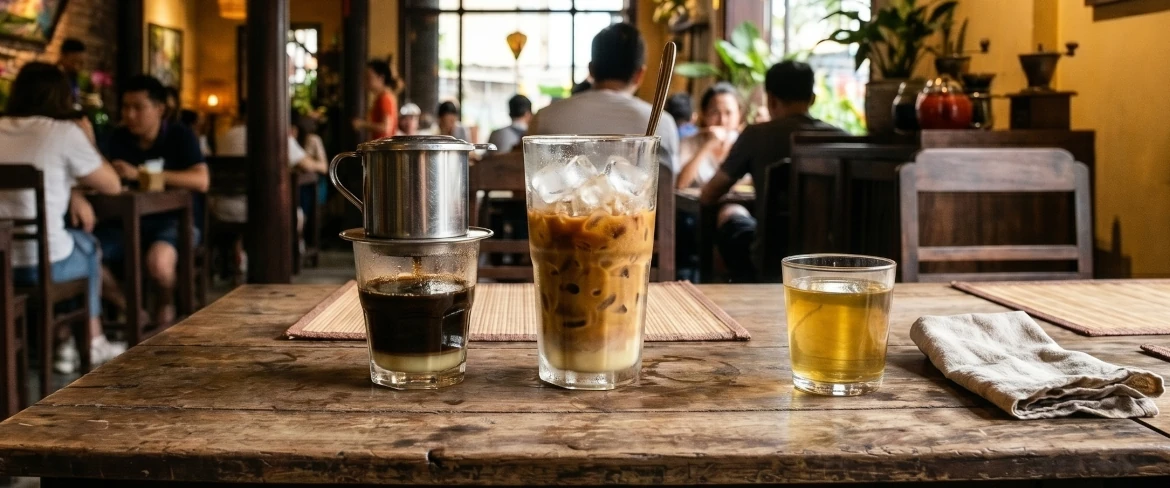
The foundation is choosing the right vessel. In this case, classic ceramic mugs or porcelain cups must definitely give way to glass. Genuine vietnamese coffee should be served in a clear, preferably quite tall glass made of thicker glass (heat-resistant). Why is this so important? The transparent walls allow you to admire the mesmerising, layered effect formed during brewing. The thick, light condensed milk rests obediently at the bottom, while a layer of pitch-black, intense brew slowly builds up above it.
The second essential element is the moment of serving and the celebration of time. In traditional street cafes in Hanoi, the beverage arrives at the guest's table while the extraction process is still ongoing. The glass with the metal phin filter placed on top is served immediately after pouring hot water over the beans. Thanks to this, the awaiting guest has a few minutes for a moment of reflection, conversation, or simply to relaxingly observe the steady drops falling into the vessel. This is the quintessence of the slow coffee philosophy!
And when does the time come for tasting? When the water has completely flowed out of the filter, it should be carefully removed. An interesting fact is that the lid of the phin filter is specially designed so that, when turned upside down, it serves as a saucer for the dripping filter – thanks to this, you will not dirty your worktop. Only at this point does the most important step take place: vigorously stirring the whole thing.
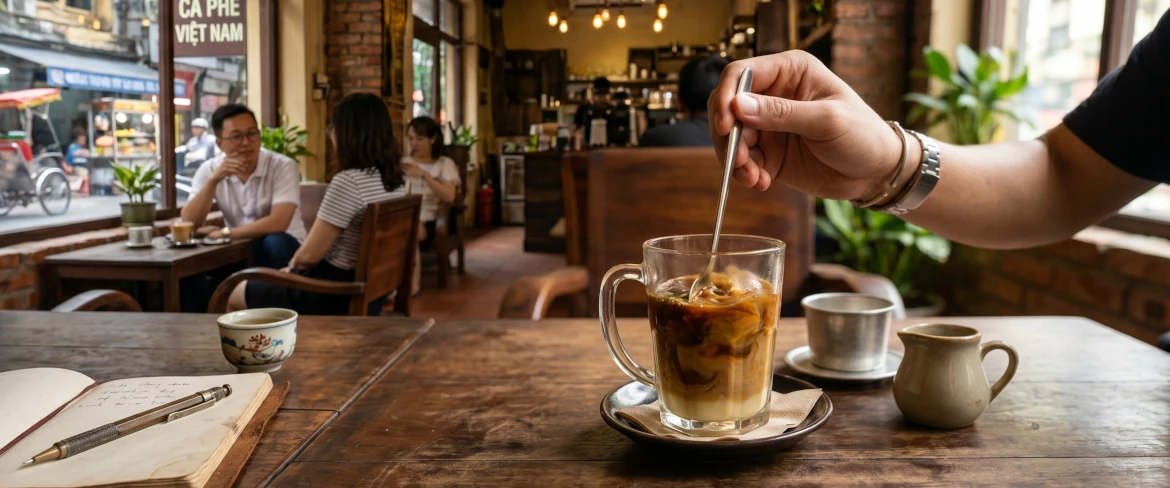
Using a long spoon, you must thoroughly mix the beverage, extracting the thick milk from the bottom and combining it with the black essence. With each movement of the spoon, the brew changes its hue from a murky black to an appetising, light caramel colour, and a delightful, sweet-coffee aroma floats in the air. The coffee is ready to drink only when its colour is completely uniform.
💡 Good to know: In the majority of Vietnamese establishments, such prepared, sweet coffee is accompanied free of charge by a tall glass of iced, delicate green tea (trà đá). It serves to refresh and cleanse the palate between sips of the heavy brew. This is a brilliant and very simple trick that you can easily utilise during your home experiments!
Vietnamese coffee at home – practical tips
To finish up, we have prepared a handful of barista tips for you, thanks to which your homemade vietnamese coffee will instantly leap to a masterful level. Although the entire brewing ritual is relatively simple and incredibly relaxing, it is the small details that determine the ultimate success. To fully enjoy this Asian speciality in your own kitchen, pay attention to these key aspects:
- ✔️ correct grind size: this is the absolute foundation, especially if you are using a phin filter. Beans ground too finely will block the pores of the dripper, resulting in the water not flowing at all or the brew becoming unbearably tart and over-extracted. Conversely, a grind that is too coarse will cause the water to rush through the coffee instantly, resulting in a watery and weak beverage. Aim for a coarseness resembling sand with larger grains – slightly coarser than for espresso, but finer than for pour-over methods;
- ✔️ water temperature control: the greatest sin when brewing any coffee is pouring boiling water over it. Boiling water literally burns the beans, extracting a flat, sharp, and very unpleasant bitterness from them, which not even the sweetest condensed milk can save. Wait about a minute after boiling the water – the ideal temperature is 90-95°C;
- ✔️ adjusting the intensity: the original recipe might seem too striking for beginners. If you want your vietnamese coffee to be slightly milder, do not shorten the brewing time (as the brew will lose its complexity). Instead, add a bit more sweetened condensed milk (as in the Bạc Xỉu variant) or serve it iced – the ice will wonderfully balance the strong essence;
- ✔️ tamping the beans in the phin filter: when using the internal press inside the dripper, do not use too much force. A light press and levelling of the surface is enough. Tamping the coffee too hard will prevent the water from piercing through the compacted "puck";
- ✔️ smart choice of beans: remember that the acidity of a light roast and the sweetness of condensed milk is quite a risky combination. Even if tradition dictates the use of Robusta, a dark roasted Arabica with a nutty-chocolate profile will work perfectly.
As you can see yourself, vietnamese coffee with condensed milk is a beverage full of contrasts – brutally strong, yet silky sweet. It is an invitation to slow down the pace, a moment of reflection, and the celebration of small things. We hope that our guide will inspire you to embark on this culinary journey. Choose the right equipment, ensure high-quality, freshly roasted beans, and create a substitute of a bustling cafe in the heart of Hanoi in your own home.
Brew, stir, and let this unique Eastern ritual permanently settle in your coffee menu!
FAQ – frequently asked questions about vietnamese coffee
1. How to drink vietnamese coffee?
Before you take your first sip, you must combine the ingredients properly. Genuine vietnamese coffee from a dripper falls into the glass in layers. Use a long spoon and vigorously stir the black essence with the sweet condensed milk from the bottom until the beverage gains a uniform, caramel colour. You can drink it hot or iced. In Vietnam, it is also a tradition to sip sweet coffee alongside refreshing, unsweetened green tea.
2. Which coffee is best for vietnamese coffee?
The original recipe relies on the dark roasted Robusta variety, which yields a heavy, earthy, and very bitter brew with a massive dose of caffeine. In a home setting, a high-quality dark roasted Arabica (dedicated for espresso) will also work perfectly, characterised by notes of dark chocolate, nuts, and caramel. Definitely avoid lightly roasted beans with high, fruity acidity.
3. How long should coffee brew in a phin filter?
The optimal extraction time in a traditional phin filter is between 4 and 5 minutes. Coffee does not pour through it freely but drips slowly – drop by drop. If the water flows much faster, it means the beans were ground too coarsely or are tamped too loosely. Conversely, too long a time (over 6 minutes) indicates too fine a grind, which can result in a tart, over-extracted flavour.
4. How does vietnamese coffee differ from espresso or drip coffee?
The difference lies in the technique and the final texture of the brew. Espresso is brewed instantly under high pressure. Drip coffee uses paper filters that retain oils, yielding a clean and delicate brew. Vietnamese coffee relies solely on gravity and a metal filter (phin). The lack of paper means that natural oils and fine bean particles make their way into the glass, resulting in an exceptionally thick, "dirty", and highly oily structured brew.
5. Can you prepare vietnamese coffee without a phin filter?
Yes. The main goal in preparing the base for this beverage is to obtain a very strong and thick coffee concentrate that will not "disappear" beneath the weight of the sweet milk. You can successfully use a moka pot by using slightly more ground beans, or an AeroPress, employing the inverted method with a smaller amount of water.
Recommended
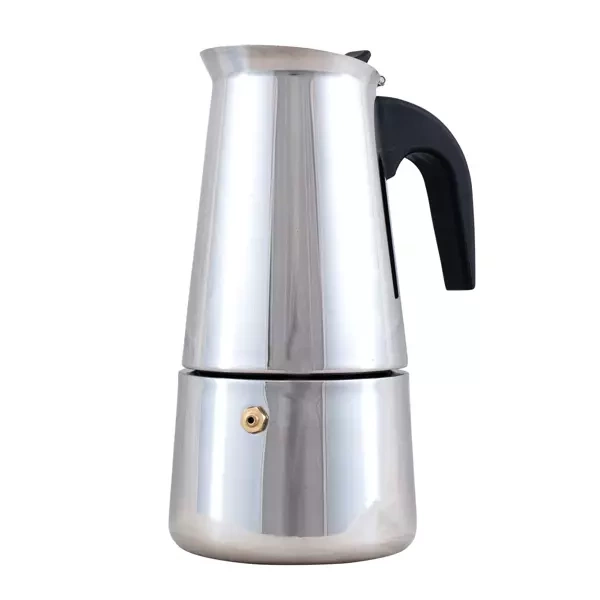
Moka coffee pot 300ml
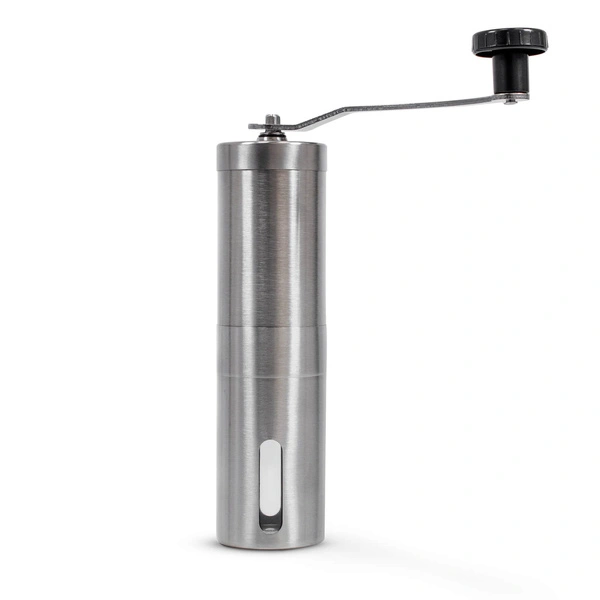
Hand coffee grinder

Coffee Broastery - Whole Bean Coffee Amico dall'Italia Espresso Roast 1kg
