
Turkish coffee – a traditional recipe for coffee from a cezve pot

Turkish coffee is one of the oldest and most ritualistic methods of brewing coffee in the world. Thick, intense, with its characteristic foam and a noticeable sediment at the bottom of the cup – for some it is the taste of childhood, for others an exotic curiosity discovered while travelling. It is also a way of preparing coffee that requires attentiveness and patience, and in return offers a full, deep body and an exceptionally concentrated aroma. Unlike filter methods or espresso, the coffee here is not filtered – we drink it whole, together with the finely ground particles that give it its distinctive character. Turkish coffee is not just a drink, but a small ritual that you can easily bring into your own kitchen.
In this article, we will show you how to make Turkish coffee at home, how it differs from other brewing methods, and where this tradition actually comes from. We will explain what proper brewing Turkish coffee involves, how to choose the right proportions, and why such an extremely fine grind is so important. There will be a bit of history, a bit of culture and – above all – a reliable Turkish coffee recipe that will allow you to prepare an aromatic coffee from a cezve pot with perfect foam and a well-balanced flavour. If you are wondering how to make Turkish coffee in a way that brings out the full potential of the beans – you are in the right place.
Summary:
- Turkish coffee – where does it come from?
- How to brew Turkish coffee?
- Turkish coffee – recipe step by step
- Brewing Turkish coffee – the most common mistakes
- How to serve Turkish coffee?
Turkish coffee – where does it come from?
Turkish coffee is primarily associated with the Middle East, Turkey and the Balkans, but its history is much richer and more international. It is a method that spread from the Ottoman Empire to successive regions of Europe and the world over the centuries.
Today, Turkish coffee is part of everyday life in Turkey, Greece, Bosnia, Serbia and Arab countries. Importantly, in each of these places it may be known by a slightly different name, yet the brewing technique remains very similar: finely ground coffee, water, often sugar, and slow heating in a small pot known as a cezve pot.
This method does not use filters or espresso machines. There are no paper filters, metal sieves or high pressure involved. Instead, there is time, patience and mindfulness – something that is often lacking in everyday haste.
The history of Turkish coffee
The origins of Turkish coffee date back to the 16th century, when coffee beans reached Istanbul from the Arabian Peninsula. It was in the Ottoman Empire that the tradition of preparing coffee in a small metal pot with a long handle – the cezve pot – developed.
💡 Worth knowing: In 2013, the tradition of preparing and serving Turkish coffee was inscribed on the UNESCO Representative List of the Intangible Cultural Heritage of Humanity. Recognition was given not only to the drink itself, but also to the entire social context, rituals and symbolism associated with its serving.
Coffee houses (known as kahvehane) became places for meetings, conversations, political debates and literary discussions. Turkish coffee was more than just a beverage – it was a social ritual.
Interestingly, this method predates many techniques known today. Before espresso machines or drippers were invented, brewing Turkish coffee was one of the most advanced ways of extracting flavour from finely ground beans.
💡 Fun fact: The grounds left after drinking Turkish coffee are sometimes used for fortune-telling – a practice known as tasseomancy. The cup with the remaining grounds is covered with a saucer, turned upside down and rotated three times clockwise. The shapes formed by the grounds are interpreted symbolically: a fish may signify wealth, a star – travel, a key – moving house, and a cat – an upcoming quarrel. This custom spread across Europe at the end of the 17th century.
Turkish coffee and Greek coffee – one method, two names?
Depending on the country, you may encounter the terms Turkish coffee or Greek coffee. Are these two different drinks?
Technically – no. Both Greek coffee and classic Turkish coffee are prepared in exactly the same way: very finely ground coffee is placed in a cezve pot with water (and optionally sugar), and then slowly heated until the characteristic foam appears.
The differences in naming are mainly due to history and the political and cultural context of the region. In Greece, from the 20th century onwards, the term “Greek coffee” began to be used, although the method of brewing remained unchanged.
- ✔️ Turkish coffee – the name used internationally.
- ✔️ Greek coffee – the same method, a different cultural background.
- ✔️ In Balkan countries, you may also encounter the term “domestic coffee”.
For us – as lovers of quality and mindful brewing – one thing matters most: regardless of the name, it is the right beans, an extremely fine grind and a well-chosen cezve pot that count. These elements determine whether coffee from a cezve pot will have an intense, deep flavour and a velvety texture.
📌 In short: Turkish coffee is one of the oldest coffee brewing methods, originating in the Ottoman Empire. Today, it exists under various names – including Greek coffee – but its essence remains unchanged: an extremely fine grind, no filtration and slow heating in a cezve pot.
In the next section, we will move on to practice and show you exactly how to make Turkish coffee step by step, so that you can fully bring out the potential of high-quality speciality coffee.

How to brew Turkish coffee?
How to make Turkish coffee so that it is thick, aromatic and finished with its characteristic foam? The key is understanding that this method does not involve simply pouring boiling water over the coffee. It is a process of slowly heating very finely ground beans together with water – without filtration and without haste.
Unlike filter methods or even the classic “pour-over in a mug”, Turkish coffee should not boil vigorously. The whole secret lies in gradually increasing the temperature, controlling the moment when the foam appears, and using the right proportions. The grind is equally important – almost powder-like, resembling flour. This is what gives the brew its intense body and velvety texture.
If you are wondering how to make Turkish coffee correctly, start with three elements: the right cezve pot, freshly ground coffee and patience. The rest is a matter of technique.
The cezve pot – the heart of brewing Turkish coffee
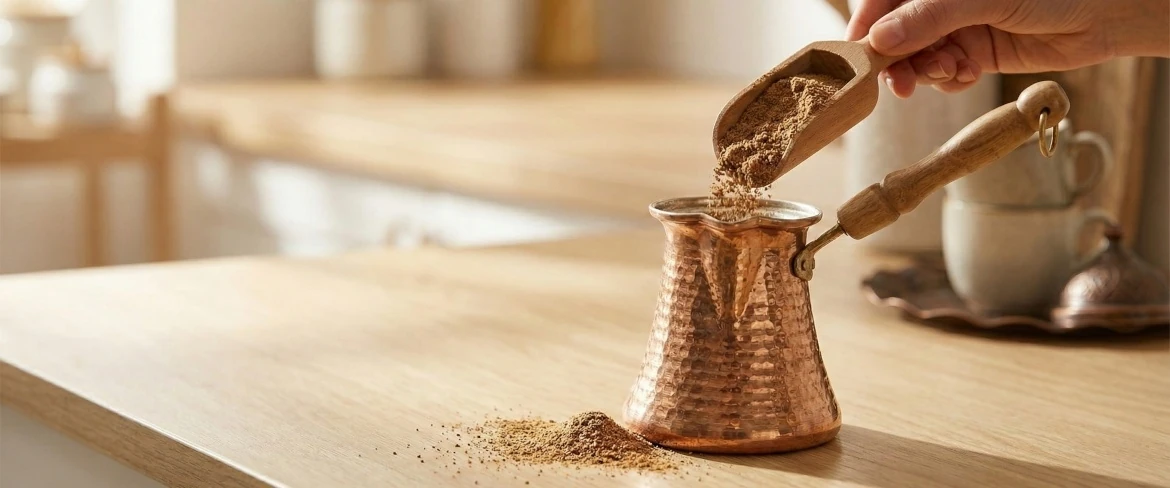
The cezve pot (also known as cezve or ibrik) is a small vessel with a long handle and a characteristic shape that narrows towards the top. Its design is not accidental. The narrow neck encourages the formation of thick foam, which is the hallmark of properly prepared Turkish coffee.
While other methods aim for a clean, filtered cup, here brewing Turkish coffee relies on full contact between the water and the fine coffee particles. The narrowing at the top of the cezve pot helps retain aromas and allows you to control the moment when the brew begins to rise.
Cezve pots can be made from various materials:
- copper – the classic choice, an excellent conductor of heat that allows precise temperature control,
- stainless steel – durable and versatile, suitable for different types of hobs,
- ceramic – heats up more slowly but retains warmth for longer.
Regardless of the material, it is the cezve pot that gives authentic coffee from a cezve pot its distinctive flavour and texture.
How to choose the right cezve pot?
Choosing a cezve pot should depend on your needs and your brewing setup. If you are just starting your journey and wondering how to make Turkish coffee at home, opt for a smaller model – around 150–250 ml. A smaller pot makes it easier to control the process and achieve better foam.
Pay attention to:
- ✔️ capacity – ideally for preparing 1–2 small cups at a time,
- ✔️ material – copper for traditionalists, steel for versatility, ceramic for aesthetics and thermal stability,
- ✔️ type of hob – not every cezve pot is suitable for induction (it must have a ferromagnetic base).
For beginners, the most important thing is to choose a model that allows you to control the temperature and easily observe the moment when the coffee begins to rise. This is when it is decided whether brewing Turkish coffee will end with perfect foam – or with a small disaster on the hob.
What coffee should you use for brewing Turkish coffee?
The most important rule is simple: the grind must be extremely fine – almost as fine as flour. If the coffee is ground too coarsely, the brew will be watery and lack the characteristic texture. If you would like to better understand why grind size matters so much, take a look at our article: Grinding coffee – why do freshly ground beans change the coffee taste?
Freshness is equally important. Turkish coffee prepared from freshly roasted beans and ground just before brewing will be far more aromatic and complex. In this method, there is no filter to “forgive” mistakes – the quality of the beans is noticeable in every sip.
When it comes to flavour profile, it is worth experimenting. A medium roast will highlight chocolate and nutty notes, while a lighter roast will bring out fruitiness and natural sweetness. To learn more about identifying flavour notes and choosing beans according to your preferences, read our guide: The flavours of coffee – a guide to flavour notes and sensory profiles.
Remember: in a method such as brewing Turkish coffee, there is no room for compromise. An ultra-fine grind, fresh beans and a properly selected cezve pot are the foundation of every successful cup.
Turkish coffee – recipe step by step
The theory is behind us – now it is time for practice. The Turkish coffee recipe below is based on classic proportions and a traditional preparation technique. In this method, details matter enormously: the right amount of coffee, cold water at the start, and patient heating without bringing the brew to a vigorous boil.
If you are wondering how to make Turkish coffee properly, treat the process as a ritual. It is not about rushing, but about controlling the temperature and observing the moment when the characteristic foam appears.
Ingredients for classic coffee from a cezve pot
To prepare one cup, you only need a few simple ingredients:
- ✔️ 1 heaped teaspoon (approx. 6–7 g) of very finely ground coffee,
- ✔️ 60–70 ml of cold water,
- ✔️ sugar – optional (added at the beginning, before heating).
For a more aromatic version, you can add a pinch of spices such as cardamom, anise or cinnamon – a popular addition in many Middle Eastern countries. Most importantly, however, the coffee must be freshly ground and extremely fine – only then will coffee from a cezve pot achieve the proper texture and intensity.
How to make Turkish coffee?
How to make Turkish coffee so that it tastes like it does in a traditional coffee house? The entire process involves slowly heating the coffee and water in a cezve pot until a thick foam begins to form on the surface. The key is not to bring the brew to a vigorous boil – too high a temperature will destroy delicate aromas and may cause the coffee to overflow.
Step 1: Measuring the ingredients for Turkish coffee
Add 1 heaped teaspoon of very finely ground coffee to the cezve pot. If you prefer your coffee sweet, add the sugar at this stage – traditionally, Turkish coffee is not sweetened after brewing.
Pour in cold water (60–70 ml) and mix thoroughly to combine the coffee and water. This is the only time you should stir before heating.
Step 2: Heating
Place the cezve pot over low heat. Brewing Turkish coffee requires patience – the brew should heat gradually. After the initial stirring, do not stir the coffee again while it is heating.
If the temperature rises too quickly, the coffee may begin to boil vigorously, which we want to avoid. Slow heating allows you to extract the full aroma and create the characteristic foam.
Step 3: The moment the foam rises
When a thick, light-brown foam begins to form on the surface and the brew clearly starts to rise, remove the cezve pot from the heat. This is the crucial moment – Turkish coffee should not boil intensely or overflow.
Traditionally, part of the foam can be gently spooned into the cup first, and then the cezve pot returned to the heat for a few seconds so that the coffee rises again.
Step 4: Serving Turkish coffee
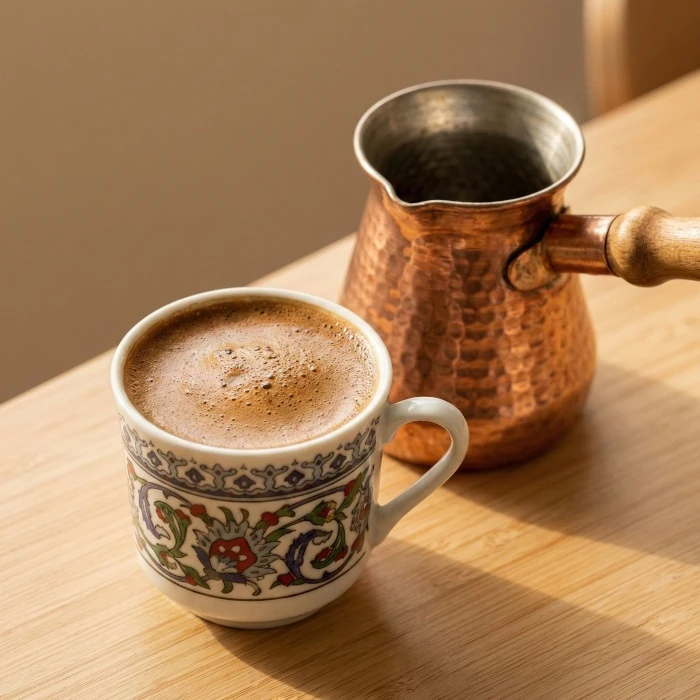
Slowly pour the coffee into a small cup – together with the grounds. The brew is not filtered. After pouring, it is worth waiting a few dozen seconds for the grounds to settle at the bottom.
Turkish coffee is prepared with respect for the process and a sense of calm. It is a method that rewards patience with a deep, intense flavour.
☕ Turkish coffee – recipe at a glance
Ingredients:
- 1 heaped teaspoon of very finely ground coffee (approx. 6–7 g)
- 60–70 ml of cold water
- optional: sugar, a pinch of spice such as cardamom, cinnamon or anise
Preparation:
- Add the coffee (and optionally sugar and spices) to the cezve pot, pour in cold water and stir.
- Heat slowly over low heat – without stirring.
- When the foam appears and the brew begins to rise, remove from the heat (do not let it boil).
- Pour into a cup together with the grounds and wait a moment before drinking, allowing the grounds to settle at the bottom.
Done – this Turkish coffee recipe results in an intense, velvety and aromatic cup.
Brewing Turkish coffee – the most common mistakes
Brewing Turkish coffee may seem simple – coffee, water, a cezve pot and heat. In practice, however, it is a method where details matter greatly. Too high a temperature, incorrect grinding or impatience can result in a brew that is bitter, flat, or even spilled over the hob.
Below you will find the most common mistakes beginners make, along with practical tips on how to avoid them. This way, your coffee from a cezve pot will be consistent, stable and full of flavour.
Why did the coffee overflow from the cezve pot?
The most common cause is simple: too high a temperature and lack of control over the process. Turkish coffee should not boil vigorously. When the heat is too high, the brew rises very quickly and can overflow in a split second. How can you prevent this?
- ✔️ Heat the coffee over low heat.
- ✔️ Do not walk away from the hob – the moment when the foam rises is brief.
- ✔️ Remove the cezve pot from the heat as soon as the foam begins to grow noticeably – do not wait until the brew starts bubbling intensely.
Remember, this method is not about boiling, but about controlled heating. That subtle difference is crucial.
Can you stir the coffee while heating?
This is one of the most common questions: can you stir the coffee during brewing? The answer is yes – but only at the beginning.
You stir the coffee with cold water before placing the cezve pot on the heat to ensure the ingredients are properly combined. Once heating begins, you should not stir the brew again. Why?
- ❌ Stirring during heating destroys the structure of the forming foam.
- ❌ It disrupts even heating of the brew.
- ❌ It may result in a less stable flavour profile.
How to avoid a bitter taste in Turkish coffee?
Bitterness in Turkish coffee may result from several factors. Most often, these include too high a temperature, heating for too long, or low-quality beans. What can you do to avoid excessive bitterness?
- ✔️ Do not allow the coffee to boil vigorously.
- ✔️ Use freshly roasted, high-quality beans.
- ✔️ Ensure an extremely fine and even grind.
It is also worth remembering that the perception of bitterness depends on the roast profile and the coffee’s natural acidity. If you would like to better understand how the balance between acidity and bitterness affects the flavour in your cup, read our article: Coffee acidity and bitterness – how to choose the perfect beans for your taste.
Well-selected beans and calm, controlled heating in a cezve pot will ensure that your brew is intense yet balanced – without an unpleasant, dominating bitterness.

How to serve Turkish coffee?
Turkish coffee is not only about the brewing method, but also about the way it is served. In the cultures of the Middle East and the Balkans, serving coffee is a form of hospitality and a celebration of the moment. It is not about a large mug drunk in a hurry, but about a small portion, an intense flavour and a calm conversation.
Turkish coffee is served in small quantities – usually 60–90 ml. It is meant to be concentrated, full-bodied and enjoyed slowly. Presentation matters: the right cup, a small saucer, sometimes a sweet treat on the side, and a moment for yourself or for sharing with others.
Traditional cups for Turkish coffee
Classic coffee from a cezve pot is poured into small cups, often without a handle or with a very thin, delicate one. Their capacity is modest – usually no more than 100 ml. This is intentional – the brew is intense and not meant to be consumed in large volumes.
In many countries, cups for Turkish coffee are richly decorated: gilding, oriental patterns and geometric ornaments. They are often placed in metal holders or decorative sleeves that protect against the heat. The small cup emphasises the character of the drink – Turkish coffee is meant to be strong, thick and served with intention.
What pairs best with Turkish coffee?
Due to its intensity, Turkish coffee pairs beautifully with sweet accompaniments. The contrast between the bold, slightly bitter brew and the sweetness of a dessert creates a harmonious combination of flavours. Traditional pairings include:
- baklava – made from filo pastry, sticky with honey and filled with nuts,
- dates and figs – naturally sweet fruits that highlight the depth of the coffee,
- halva – especially firm sesame halva or the fluffy Pişmaniye variety, resembling candy floss that slowly melts in the mouth while sipping the coffee,
- lokum (Turkish delight) – jelly-like sweets that are delicate and melt in the mouth.
If you choose coffee with a chocolate-and-nut profile, it will pair wonderfully with nut-based or caramel desserts. Lighter roasts, with fruity notes, combine well with dates or honey-based sweets.
Is water always served with Turkish coffee?
In Turkish and Greek tradition, a glass of cold water is very often served alongside the cup of coffee. This is not accidental, nor is it purely decorative.
The water is drunk before the coffee – its purpose is to cleanse the palate so that you can fully appreciate the aroma of the brew. This makes the first sip more expressive and allows you to better perceive the flavour profile of the coffee.
Serving water is also a symbol of hospitality. In many homes and cafés, it is an essential element of the ritual – just as important as the Turkish coffee itself.
Finally, it is worth remembering that whether you call it Turkish coffee, Greek coffee or simply coffee from a cezve pot, the most important factors are the quality of the beans and mindfulness in preparation. These are what determine whether each cup becomes a small, meaningful ritual.
Brew your Turkish coffee, slow down for a moment and let every cup become a small daily ritual.
FAQ – frequently asked questions about Turkish coffee and its preparation
1. How long should you brew Turkish coffee?
Turkish coffee does not have a strictly defined brewing time in minutes – observing the process is key. Heating usually takes between 2 and 4 minutes over low heat. The most important thing is to remove the cezve pot from the heat at the moment when the foam clearly begins to rise. Turkish coffee should not boil vigorously.
2. Does Turkish coffee need to boil?
No. This is one of the most common mistakes. Brewing Turkish coffee involves slow heating rather than boiling. Bringing the brew to a vigorous boil can destroy delicate aromas and cause excessive bitterness. The coffee should simply rise – that is when you remove the cezve pot from the heat.
3. Can you use regular ground coffee for Turkish coffee?
Yes, but on one condition – it must be ground extremely finely, almost like flour. Most standard pre-ground coffees available in supermarkets are too coarse. If you are wondering how to make Turkish coffee properly, it is best to grind fresh beans just before brewing, using the finest setting on your grinder.
4. What are the best coffee-to-water proportions?
The classic ratio is 1 heaped teaspoon (approx. 6–7 g) of coffee per 60–70 ml of cold water. If you prefer a stronger brew, you can slightly increase the amount of coffee, but remember that coffee from a cezve pot is naturally intense and concentrated.
5. Can you prepare Turkish coffee without a cezve pot?
In an emergency, you can use a small saucepan. However, a traditional cezve pot has a special narrowing shape that helps create foam and gives you better control over the process. If you care about authentic flavour and texture, it is worth investing in the proper equipment.
6. Is Turkish coffee very strong?
Yes – Turkish coffee is intense because it is not filtered and contains fine coffee particles. It has a full body and a concentrated flavour, but you can adjust its strength by modifying the proportions and choosing beans with a milder roast profile.
7. Do you drink the grounds in Turkish coffee?
No – the grounds naturally settle at the bottom of the cup. After pouring, it is advisable to wait a few dozen seconds before taking the first sip. It is normal for Turkish coffee to contain sediment – this is a characteristic feature of the method.
Recommended
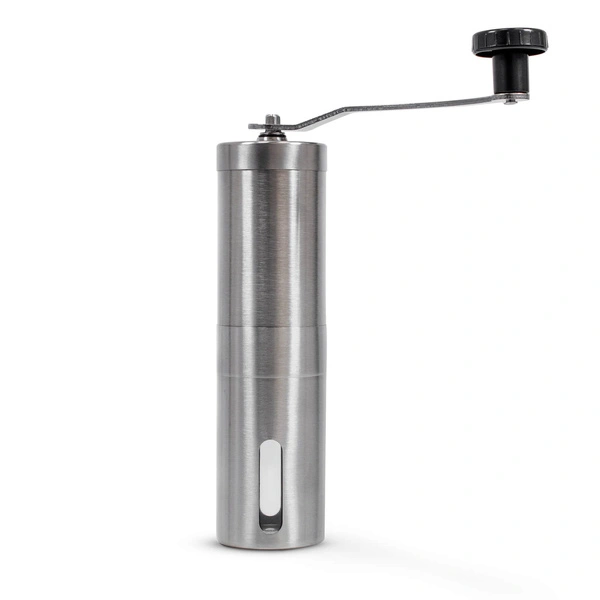
Hand coffee grinder
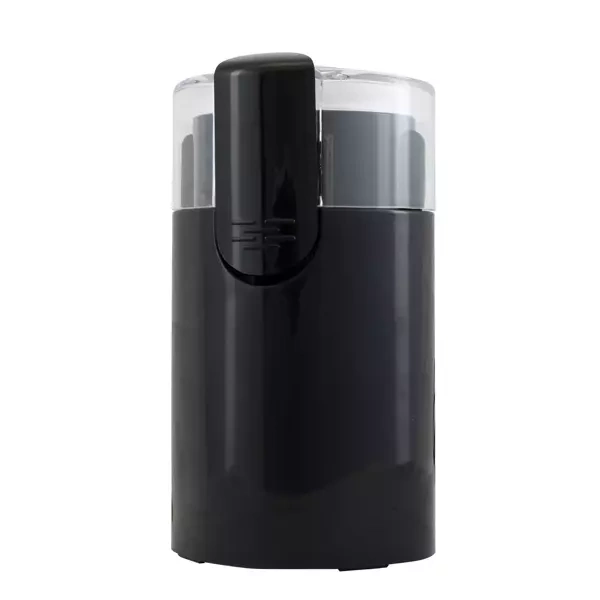
Electric coffee grinder 150W

Coffee Broastery - Whole Bean Coffee Brazil Guaxupe Premium 1kg
